Rebranding: adjusting or renewing a brand
The business world and consumer markets are in constant transformation. Technologies, audience habits, the competitive environment and economic realities all change. In these conditions, no company, however successful, can afford to stay static for decades. When a business outgrows its current image, when its old meaning no longer resonates with clients, or when the company radically changes its direction, it is time for decisive steps. Rebranding is a powerful tool for a strategic reset. It is not just a change of “wrapping” but a deep rethinking of the company that allows it to adapt to new challenges, reach its goals and open new horizons for growth.
What is rebranding?
Comprehensive rebranding is a deliberate change of a company’s strategic course and visual image to change how its audience sees it. It is a deep brand transformation that touches the essence of the brand: its philosophy, mission, values, value proposition and messaging. A brand renewal tells the market, partners and clients that the company is evolving, getting better and more contemporary, and is ready for new heights.
How is rebranding different from restyling and full branding?
To make the right management decisions, business owners must understand the difference between these processes:
- Brand restyling (or brand redesign) is a purely surface change of the visual shell — for example, modernising the logo or adjusting the corporate colours — without touching the strategy. The meaning stays almost the same.
- Full branding is creating a company or product from a blank page. It is a process for start-ups or entirely new ventures that have no history or reputation in the market yet.
- Rebranding is a process that works with an existing asset. It combines renewing the foundation (strategy and positioning) with a subsequent change of the visual side. The main task is to use the accumulated brand equity (recognition, the trust of part of the audience), cut away everything outdated and build a new, more effective system on that basis, in line with business goals and market realities.
What does rebranding include?
A professional rebranding process is a complex, multi-stage project that cannot be done in a few days. It needs a creative team (strategists, marketers and designers) and the direct involvement of the owner or leadership. The process has several fundamental blocks.
Brand audit of the current state. Any large-scale change must be based on objective data, not on the assumptions of the owner or the team. That is why the process always starts with diagnosis. We research how the market currently perceives the brand, analyse audience loyalty and the activity of key competitors, and record weak points. The audit shows which elements of the old brand are highly valued by clients and worth keeping, and which are dead weight.
Updating positioning and strategy. This is where the real rebranding strategy is born. A new brand platform is formed that matches current business goals. Repositioning the brand may involve changing the price segment (for example, moving from mass market to premium or vice versa), changing the core audience or focusing on new unique product features. Sometimes this stage also includes renaming the brand, if the old name limits growth or carries negative associations.
Renewing the visual identity. Design work begins only once the new meaning is approved. Renewing the identity makes the new strategy visible to customers. The corporate style is updated: a new logo, new corporate colours, typefaces, patterns and rules for applications. The visual language must fully match the company’s new positioning and character.
A plan for communicating the change to the audience. One of the most important and at the same time most difficult stages. Changing on the inside is only half the job; it is essential to convey these changes to the market correctly. Rebranding communication must be carefully planned, so that long-standing, loyal clients do not feel betrayed and understand the reasons for the transformation, while new clients notice the renewed company.
What does the business get?
Investing in rebranding a company is an investment in its future value and its ability to compete in a changed economy.
A renewed image for a new stage of the business. Successful companies often face “garage branding”: an image improvised at the start no longer fits a national or international company with a multi-million turnover. Rebranding brings the company’s outward image in line with its real quality and expertise.
Recognition preserved with a renewed look. Owners’ main fear about transformation is the risk of losing a loyal client base. A professional approach ensures renewal without loss of recognition. By partially keeping key visual anchors (continuity in design) and running the right launch campaign, clients easily recognise their favourite brand in its new, better form.
Growing audience trust and interest. Any large-scale brand renewal is a powerful news hook. It attracts the attention of the media, the expert community and the wider public. It is the ideal moment to announce your new quality standards, reach the consumers who used to ignore your product and win back the interest of former clients.
How does rebranding work?
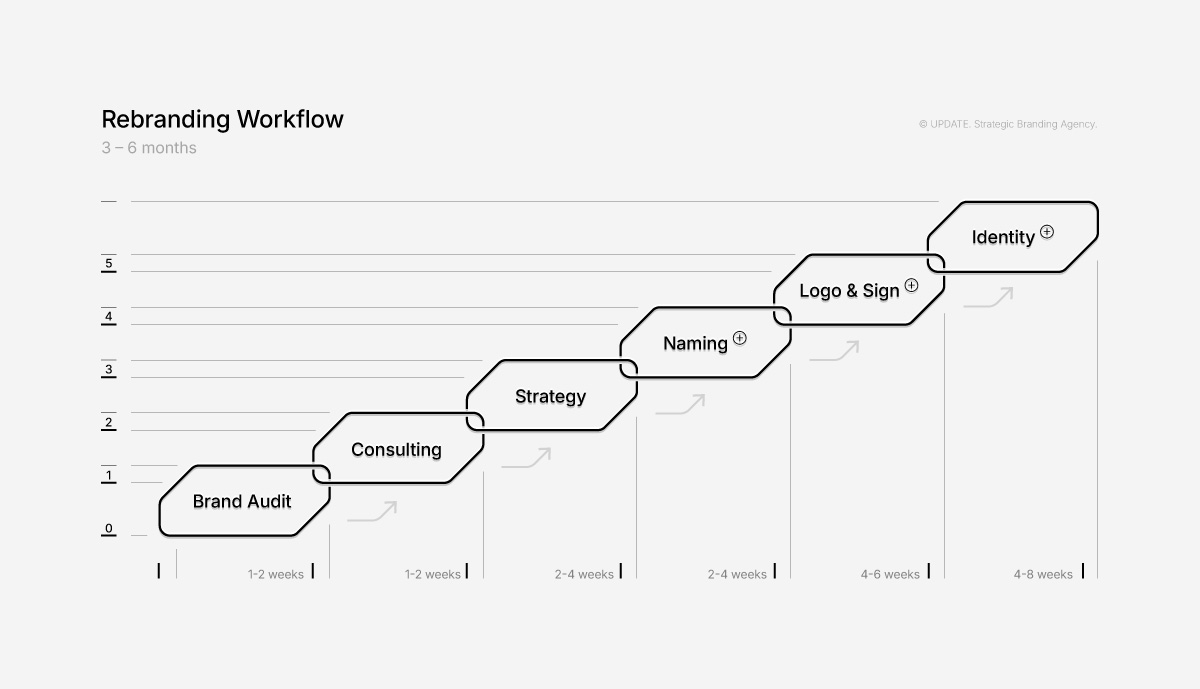
At UPDATE AGENCY we apply a proven methodology that minimises risks and ensures a smooth transition from the old image to the new one.
Audit of the current brand. We interview stakeholders, study sales analytics, and analyse the competitive environment and how the market sees the company.
Defining the key reasons for rebranding. It is important to state clearly why we are doing this. We formalise the key reasons for rebranding and set clear goals to be reached once the changes are in place.
Developing the updated strategy and identity. This is where ideas are generated and packaged. Strategists update the positioning and brand architecture. Art directors and designers develop several concepts for the renewed visual style and test them on real applications (mock-ups).
Implementing and communicating the rebrand. Once each stage is approved, we create detailed guidelines (a brand book) for your team. We also help plan the launch of the renewed brand: from an internal presentation that turns employees into ambassadors of the change to a large-scale external campaign.
Who needs rebranding?
A full transformation is necessary and justified in the following cases:
- Mergers and acquisitions (M&A). When several different organisations merge, they need a new, single brand that unites the teams and avoids conflicts of interest.
- Entering new markets. When a local business goes international, its name, identity or positioning may be unclear, irrelevant or even legally unavailable in other countries.
- A radical change of product or business model. When a company stops selling tractors and starts selling software for the agricultural sector, the old image will only get in the way.
- Loss of relevance and competitiveness. The brand’s design and communication are stuck in the last decade, and the company keeps losing a younger audience to more contemporary competitors.
- The need to leave a negative reputation behind. Sometimes a company carries so much negativity — from past management mistakes or scandals — that the best solution is a relaunch with a new name and new standards.
How much does rebranding cost?
We always assess each budget individually. The answer to the question of rebranding prices depends on the scale of the problem and on how ready you are for real change and investment. A project can be a fairly quick repositioning with a logo update for a local brand — or a new name, in-depth research and dozens of applications for a large corporation with many departments and divisions. The price of rebranding includes analysis, strategic consulting, the creative team’s work and support during implementation. Remember that this is a strategic investment: a well-executed transformation pulls a business out of stagnation and opens the door to new financial opportunities.
Rebranding at UPDATE AGENCY
At UPDATE AGENCY we know that changing a brand is stressful for a business. That is why we act not just as contractors but as reliable partners who guide you through every stage of the transformation. We combine an analytical base, expertise in business strategy and a European approach to visual communication. We treat your heritage with care, keeping what works and deliberately cutting away whatever holds back your growth.
If your business needs a fresh start, a way out of a crisis or preparation for a quantum leap, you can commission a rebrand from our strategic branding agency in Kyiv. We will not only “repair” your brand so that it runs as reliably as a Swiss watch, but also inspire you to pursue new ambitious goals.

FAQ
Restyling is a cosmetic change of graphics: a slightly different typeface, a fresher colour, a more contemporary or minimalist logo. Rebranding changes the foundation — values, promises, target audience and positioning — and that, in the end, changes the design too. Restyling works with appearance; rebranding works with essence.
Typical signals: sales stagnate even as advertising budgets grow; you are entering new international markets; there is a merger or acquisition; the product line has changed significantly; you look outdated next to competitors; or you are moving to a different price segment.
A comprehensive process that includes an audit, strategy development, naming (if needed), a visual system and a communication plan takes 2 to 4 months on average. The depth and duration depend on the scale of the company.
The budget is set individually and depends on many factors. For example: whether you need a new name and a legal check, how much sociological and marketing research is required, how deep the brand strategy goes and how many brand applications must be designed anew.
Recognition is preserved through continuity: for example, keeping the brand colour or the recognisable shape of the mark while modernising them. A detailed transition campaign also helps. It explains the changes to clients in advance and shows that the product has become even better and the company more contemporary.